Edge connector options for V6 modules
Every way found so far to join a Jumperless module to the main board along an edge, with what each costs in board area, height and money: one 70-way connector, or two or three smaller ones so half a breadboard can be swapped for something else. Catalog parts, Chinese and Taiwanese makers that are not (or barely) on LCSC, the custom "kiss slot" coupler, SFP-style right-angle sockets, the single-contact SMT plug-and-socket clips, and the shorted-when-empty type. Each coplanar and right-angle part can be seen on a real wig and barnacle in the 3D viewer. Vertical-mount parts are kept in the data but hidden unless the geometry filter asks for them. Dimensions are read from the makers' drawings and prices from listings as of 22 Nov 2026; anything marked ≈ is an estimate. Yuan prices are converted at ¥6.7 to the dollar.
Pick a split, see the area
| option ↕ | pitch | contacts | edge holds | edge used | depth | dead area | Z | price | plan view |
|---|
Dead area is PCB that can hold nothing else. On a coplanar joint it is connector length × the whole strip from the back of the host pads to the tip of the module's tongue (host depth + board gap + tongue). On a vertical or raised joint it is the connector's footprint on the host plus the module's tongue. Host depth is solder legs on a straddle part, body plus about 1.8 mm of SMT leads on a vertical one, and body plus tails on a right-angle one. Gap is the distance from the host's edge to the tip of the card on a coplanar joint; tongue is the depth of the module the connector takes. Z height is how far the part stands off the board: total thickness for a coplanar part. Edge used allows 2 mm between connectors and turns orange when it exceeds the edge available. The signal count is a minimum: a connector with more contacts than asked for is fine and its extras are listed as spare, and edge holds is the most contacts that option could put on the edge with that many connectors. Depth reads host + gap + tongue for a coplanar part and host + tongue otherwise. A fixed-size part (PCIe, M.2) uses as many connectors as the signal count needs. Price is the listed price of the nearest size, scaled by contacts0.75 to the size used. Hover a row for its notes, hover a picture to enlarge it, click a name for the maker or distributor page with the datasheet and price (opens in a new tab), and click a plan view to open that part in the 3D viewer.
What the numbers say
- At 1.27 mm a card edge will not split. Two 36-way housings need 59.9 mm and three 24-ways 68 mm, against the 50.5 mm one 70-way uses, because every housing brings its own 7.4 mm of end walls. A custom housing with one divider wall should carry 2 × 34 contacts in the same 50.5 mm (an estimate: 1.2 mm walls, today's 2.3 mm tongue margin).
- Two connectors on a 51 mm edge, from stock. Coplanar: Samtec MEC8-EM (2 × 40 in 49.6 mm, about $7.80 the pair) or the 1.27 mm header pair (2 × 36 in 48.5 mm, $0.58). Right angle: Samtec MEC6-RA or MEC8-RA, two TE Sliver 56-ways (46.7 mm), two M.2 sockets, or four SFP sockets. Three only fit as 1.27 mm header pairs (3 × 24 in 50.9 mm), four SFP sockets, or Oupiin's 0.635 mm right-angle part.
- Coplanar from stock means a straddle part: a 12 to 14.5 mm strip with the boards about 2 mm apart at best, against 18.3 mm and 6.4 mm today. The XKB PCIe straddle is $0.57 but its screw ears make it 34.8 mm long.
- The kiss slot is still the only card-edge option with the boards touching and a strip under 10 mm, and it is 5 mm thick where the straddle parts are 7 to 9.
- SFP-style for a 1.6 mm card is the SFF-TA-1002 family (TE Sliver, Amphenol Mini Cool Edge): a right-angle 56-way is 22.3 × 11.1 × 5.35 mm, and there is a straddle version. It costs $4.40 to $5.80 a piece in reel quantities with a 12 to 16 week lead, and puts 0.6 mm fingers on the barnacle. More under SFP-style parts.
- 1.27 mm pin headers are the cheap coplanar answer if the barnacle may carry a part. A right-angle socket on the wig and a right-angle pin header on the barnacle put 78 contacts on the edge for about $0.50 with the boards touching, 3.4 mm tall on one face and through holes in both boards. Straddle-mounting the same headers would stand only 0.9 mm proud of each face with no holes, but catalogue tails fit 0.8 to 1.0 mm boards, not 1.4 or 1.6: that version needs tails formed to order. Sections under pin headers. 2.54 mm fits only 38.
- At 2.54 mm across the full wig, 30 contacts a row line up with the breadboard's columns. One SMT part on each face (stock, boards touching) leaves the rows 3.9–4.1 mm apart, not 2.54. A dual-row header straddling each edge gives exactly 2.54 and 60 contacts; three rows give 90, with the 30 special signals in the boards' own plane, but need formed tails. Both straddle versions put 11 mm between the boards. Under 2.54 mm rows.
- Cheapest per contact is M.2: 67 contacts for $0.18, if a 0.8 mm card raised above the host at 0.5 A a contact is acceptable.
The options, one by one
SFP-style sockets and straddle parts for a 1.6 mm card
An SFP socket is a small right-angle SMT part that a module card slides into, parallel to the host and a couple of millimetres above it. The real one is 20 contacts at 0.8 mm in 11.0 × 9.4 × 5.2 mm and costs $0.29 (HCTL HC-SFP-20P at LCSC), but its card is 1.0 mm thick. Parts built the same way for a 1.57 to 1.6 mm card:
| family | what it is | size | price |
|---|---|---|---|
| SFF-TA-1002: TE Sliver 2.0, Amphenol Mini Cool Edge | The EDSFF / OCP NIC 3.0 connector. 0.6 mm pitch, 56 / 84 / 140 / 168 contacts, 1.1 A, in vertical, right-angle and straddle versions. 50 to 200 mating cycles by plating. | right-angle 56-way 22.3 × 11.1 × 5.35 mm, card 3.05 mm above the host (drawing); straddle 84-way 33.9 mm body, 39.7 with screw ears, 14.55 deep, 8.9 thick (drawing) | right-angle 56-way €4.03 ≈ $4.42 at 2,000 (Farnell, 12 weeks); straddle 84-way zł23.75 ≈ $5.84 at 1,536 (Farnell, 16 weeks); Amphenol ME20 56-way right-angle $19.99 in ones (LCSC, out of stock) |
| Samtec HSEC8, MEC8, MEC6, MEC1 | 0.635 to 1.0 mm, 1.6 mm card, right-angle (-RA) and edge-mount straddle (-EM). In the calculator above. | MEC6-RA 80-way 28.6 × 9.1 × 5.8 mm; MEC8-EM strip 13.5 mm | $3.70 to $4.40 at 1 k for 40-way |
| PCIe ×1 right-angle and straddle | 1.0 mm, 36 contacts, 1.57 mm card. Straddle: XKB X3126WS, UMAX 3126. Right-angle: Samtec PCIE-036-02-F-D-RA, Dongguan Youmao's 64-way. | 25 mm body | XKB straddle $0.57; Samtec right-angle (through-hole) $5.70 in ones (LCSC, out of stock) |
| Solepin 61C6 | Listed as an SFP-style 0.8 mm socket in 4 to 100 positions with a 1.60 mm PCB, full gold, 1 A, 15 to 20 day lead. Its only drawing is the standard 20-way with a 1.00 mm card, so whether they will make a longer one for 1.6 mm is a question to ask, not a stock part. | 20-way 11.0 × 9.4 × 5.2 mm | ask |
| Solepin 61F9 | 1.27 mm, 90° SMT straddle, any 6 to 300 contacts, for 1.6 to 2.0 mm boards. The closest Chinese part to today's WingTAT in a soldered straddle form. | no drawing online | ¥40 ≈ $5.97 sample |
The M.2, mini PCIe, SO-DIMM and MXM sockets are the same idea for thinner cards (0.8, 1.0 and 1.2 mm) and do not take 1.6 mm.
1.27 mm pin headers: right angle, or straddle mounted
Three sections through one pin, to scale, with the 1.4 mm wig on the left and the 1.6 mm barnacle on the right. Dimensions are from the makers' drawings: XKB X1321FR (right-angle socket), Kinghelm KH-1.27PH90 and XFCN PZ127V (pin headers), Antenk FHCU01 (straddle socket). The same parts are modelled pin by pin in the 3D viewer: right angle, straddle (untick "tails formed to the boards" there to see B).
Can they be straddle mounted? Not on 1.4 or 1.6 mm boards with catalogue parts. The two rows are 1.27 mm apart whatever the maker, so a pin header with 0.4 mm square pins has 0.87 mm between its rows, and the one drawing of a straddle (夹板) socket I could get at this pitch, Antenk's, shows its tails pinched to 0.50 mm. As they come, these suit boards of 0.8 to 1.0 mm at most. A straight 2.54 mm header has 1.9 mm between its pins, which is why straddling a 1.6 mm board is routine at that pitch and not at this one.
| A · right angle, through-hole | C · straddle, tails formed | |
|---|---|---|
| contacts on a 51 mm edge | 78 (2 × 39, 49.9 mm) | 78 (2 × 39, 49.9 mm) |
| strip: wig + between + barnacle | 6.3 + 0 + 5.3 = 11.6 mm | 2.7 + 5.3 + 2.5 = 10.5 mm |
| thickness | 3.4 mm above the top faces, and tails 1.0 mm out of the wig's underside | 3.4 mm in all: 0.85 mm proud of each face of the wig, 0.9 mm of the barnacle |
| what it takes from the boards | two rows of 0.7 mm holes through each board | a row of 0.76 × 2.5 mm pads on each face of each board; no holes |
| where the boards end up | touching; the barnacle's top face 0.2 mm below the wig's | 5.3 mm apart (or the bodies recessed in notches); centred on each other, faces within 0.1 mm |
| board thickness | any | 0.8 to 1.0 mm from the catalogue; 1.4 and 1.6 mm only with tails formed to order |
| price for 2 × 40 | ¥3.55 ≈ $0.53 from stock (socket ¥2.1, pin header ¥1.45) | socket listed at ¥0.06 ≈ $0.009 from 10,000 (Yonglifeng; read as a per-pin price), so about ¥4.8 ≈ $0.72; pin header about ¥1.45 ≈ $0.22; forming is extra and unquoted |
What would make the straddle version real:
- Ask for formed tails. The socket's tails have to end up 1.4 mm apart instead of 0.50, and each row of the pin header has to be bent out 0.37 mm to clear a 1.6 mm board. Straddle sockets are sold to order rather than off a shelf (Antenk FHCU01, 2 to 100 contacts, minimum order 1,000; Yonglifeng, from 10,000; Huifeng 回峰 lists an H = 4.4 one), and the same style at 2.54 mm is drawn with its tails formed to 1.00 mm, so the gap looks like a parameter. I found no listing for 1.4 or 1.6 mm at 1.27 pitch, and none for a straddle pin header at this pitch, so both need a drawing and a quote.
- Or thin the barnacle. A 0.8 mm barnacle takes a stock straight pin header as it is (0.87 mm between the pins). The wig is still 1.4 mm, so its socket still needs formed tails.
- What a straddle joint lacks: nothing grips the boards but the solder. Every push and pull goes through the pads in shear, where a card-edge straddle connector has moulded legs or a slot. With pads on both faces that is probably fine, but it wants a pull test before it is trusted.
- Two leads not yet checked against a drawing: headers with 1.27 mm pitch and 2.54 mm between the rows (Antenk lists pin headers and sockets), whose pins would stand about 2.1 mm apart, loose on 1.6 mm and right for 2.0 mm; and horizontal surface-mount (卧贴) 1.27 mm pairs, which keep everything on one face like A but without the holes.
2.54 mm across the full width: one part on each face, or three rows
At 2.54 mm, 30 contacts a row take 76.6 mm, which is as many as the 78.7 mm wig holds (31 would be 79.1), and puts every contact at the breadboard's own pitch: the two rows of one column, one above the other. Sections through one column, to scale, from the drawings of the Hanxia PM2.54 WT socket, the XKB X6511WRS pin header, the Hong Cheng 2 × 30 socket and the HCTL three-row socket. All three are in the 3D viewer: D, E, F.
One surface-mount part on each face does not give 2.54 between the rows. Every 2.54 mm right-angle SMT part I found has its pin or contact in the middle of a 2.5 mm body, 1.25 mm above its pad, so the rows end up 1.4 + 2.5 = 3.9 mm apart on the wig and 4.1 mm on the barnacle. For 2.54 the pins would have to sit 0.57 mm and 0.47 mm above the faces, lying almost on the pads. 1.27 mm parts are no closer: XKB's single-row SMT pin header has its pin 1.0 mm up a 2.0 mm body (rows 3.4 and 3.6 mm apart) and Hanxia's 1.2 mm up 2.4 mm. A dual-row header straddling the edge (E) gives exactly 2.54, because one housing holds both rows.
| D · SMT part on each face | E · dual-row straddle | F · three rows | |
|---|---|---|---|
| contacts in 76.6 mm | 60 | 60 | 90: 60 breadboard rows + 30 in the board's plane |
| rows apart | 3.9 (wig), 4.1 (barnacle); each pin 0.1 off centre unless the boards match | 2.54 | 2.54, middle row on the boards' mid-plane |
| strip: wig + between + barnacle | 11.9 + 0 + 5.9 = 17.8 mm | 3.0 + 11.0 + 3.0 = 17.0 mm | 3.0 + 11.0 + 3.0 = 17.0 mm |
| thickness | 2.5 mm on each face | 5.1 in all, 1.7–1.8 proud of each face | 7.6 in all, 3.0 proud of each face |
| boards | touching | 11 mm apart, bodies between them | 11 mm apart, bodies between them |
| parts | stock: Hanxia PM2.54-1x30P WT (to 1 × 40), XKB X6511WRS-30H (to 40). XKB's own SMT socket stops at 10. | pins stock (fit 1.6 mm with 0.15 a side); sockets need tails formed in for 1.4 mm, which 1688 sellers already list for 1.0 and 1.2 mm boards | stock 3-row headers in both genders, but the outer tails stand 1.4–1.6 mm off the faces and must be formed in: to order |
| price a joint | about $1.30, scaled from 10-way LCSC prices | about $0.40 (socket $0.274 at LCSC + pin header) | about ¥2.1 ≈ $0.31 from 1688 listings, before forming |
| mates with | itself | anything 2 × 30 at 2.54, such as a 60-way IDC ribbon socket | any 3-row 2.54 socket or pin header |
- Stiffening. In D nothing ties the two parts on a board together but the board: each is placed to its own pads (about ±0.1 mm), which 2.54 sockets absorb. The bars do sandwich each board's edge from both faces. In E and F one housing carries every row, so the rows are in register by construction, and the bodies bridging the 11 mm gap are the stiffener.
- Breadboard rows apart from everything else is what F does: each column's two breadboard rows on the outer rows, and rails, LED data, I²C and the magnetometer lines in the middle row, in the boards' plane. Its tails go into plated half-holes cut in the edge. Those half-holes share each column with the outer rows' pads, so the outer pads start about 1 mm back from the edge with solder mask between, and the formed outer tails step down after that.
- Plugging force adds up at this pitch. XFCN quotes insertion up to 250 gf a contact for its machined 2.54 sockets (withdrawal over 70 gf); at that rate 60 contacts take up to 15 kgf to push home and 90 up to 22 kgf. The stamped sockets here publish no figure, so it wants measuring on a sample before committing.
- In the calculator above, set signals to 60 (or 90) and the edge to 78.7 to compare these with the 51 mm options; at the default 70 signals on 51 mm they show as too long.
Makers to ask: no full drawing or price yet
These turned up in the off-LCSC search but without enough numbers to put in the calculator. Solepin is the one to start with: it sells any even pin count in 0.8, 1.0 and 1.27 mm with a 10–20 day lead and sells singles on 1688. No Chinese maker lists a 0.8 mm straddle (edge-mount) part; Solepin, LXW and Shunyi make the vertical version and would be the ones to ask for it.
| maker | part | what it is | price |
|---|---|---|---|
| Solepin 硕品 (Dongguan) | 61F9 | 1.27 mm SMT straddle, any 6–300 contacts, optional ears, PA9T, 3 A. Same idea as today's WingTAT at any length. | ¥40 ≈ $5.97 sample (1688) |
| Solepin 硕品 | 61D3 | 1.0 mm vertical SMT, Samtec HSEC1-compatible, 10–200 contacts in any combination, keyed. | ¥30 ≈ $4.48 sample (1688) |
| Solepin 硕品 | 66F6 / 61F6 | 1.27 mm vertical SMT, Samtec MECF-compatible, any 4–200 contacts, 2 A. | ask |
| LXW 连兴旺 (Shenzhen) | HSEC8-compatible | 0.8 mm vertical SMT, 20–200 contacts, 3 A. A Samtec-clone house. | ask |
| Dongguan Shunyi 顺宜 | HSEC8 replacement | 0.8 mm vertical SMT, 10–200 contacts. Also 1.27 mm burn-in slots. | ¥25 ≈ $3.73 single |
| Yueqing Beijie 倍杰 (Wenzhou) | straddle · vertical SMT | 1.27 mm PCI-style slot in straddle and vertical SMT. Cheapest straddle found, no documentation. | ¥0.85 ≈ $0.13 listed |
| Sunny Young 杉洋 (Taiwan) | R6830 | 1.27 mm in straddle, SMT and DIP. Same 8.88 × 14.0 mm geometry as the WingTAT (drawing). | ask |
| Oupiin 歐品 (Kunshan) | 8206-2…RPT · 8236 | 0.8 mm right-angle (2 × 10, 2 × 20; a MEC8-RA look-alike, 12.05 mm deep) and a 1.27 mm vertical 80-way (54.9 mm long). | ask |
| Dongguan Youmao 友贸 | PCIe ×4 right-angle | 1.0 mm, 64 contacts, right-angle. The only right-angle PCIe-style socket found. | ¥10.4 ≈ $1.55 |
| Shenzhen Dongfang Yutong 东方宇通 | 1.0 mm straddle | Trader with a photo-only catalogue: 1.0 mm straddle, SMT and DIP, plus 0.8 mm SMT. Shows a 1.0 mm straddle exists in the Shenzhen market. | ask |
Printing the pinout on the connector
Labelled headers already exist as products, so this is a known job for a header factory or a small print shop: Arduino sells printed MKR headers ($1.50 for a 14-way strip, retail), and Where Labs sells Pico headers with a two-layer black-and-white silkscreen, straight or right-angle, at $4.95 a pair retail, printed for them by a small silkscreen shop. None of the prices below is a quote for this job: they are 1688 listing prices for the same processes on other small plastic parts.
| route | set-up | per piece | what it suits |
|---|---|---|---|
| Header factory prints it | in the unit price | ¥1.31 ≈ $0.20 each from 10,000 (Yonglifeng 永丽丰: coloured 2 × 40 pin-header bodies, 2.0 / 2.54 mm, "pad-printed to the customer's requirement") | The cheapest route at volume, and the part arrives finished. That listing is for pin headers with a 10 k minimum; it shows header factories take the job, so ask the socket makers above for the same on a smaller run. |
| Pad printing (移印) at a print shop | ¥50–94 ≈ $7.5–14 per etched plate (plate, plate with free artwork) | ¥0.07–0.20 ≈ $0.01–0.03 (Yuyao Chengfeng, Shanghai Jingshi) | Opaque white (or any colour) on black plastic: the Arduino look. Comfortable at 2.54 mm pitch with characters around 1.5 mm; at 1.27 mm the text is at the edge of what pad printing holds. |
| Laser marking (镭雕) at a shop | none listed | ¥0.05–0.30 ≈ $0.007–0.045 (Shajing Xiongdaxing ¥0.05 from one piece, Dalingshan Baoyao UV ¥0.10 from 100, Dingfu ¥0.30) | No plate, so the artwork can change per batch, and the line is fine enough for 1.27 mm pitch. The mark is light grey or tan on black nylon or LCP, not white; a UV laser gives the best contrast. |
| Your own UV laser marker | ¥6,800 ≈ $1,015 for a 3 W desktop machine (Dongguan Bowei) | time only | Pays for itself against shop marking at a few tens of thousands of parts, and marks anything else on the bench. |
| Moulded in | part of the housing tool | nothing | Only for a custom housing such as the kiss slot: raised or sunk characters cut into the mould, optionally tipped with ink afterwards. |
What fits. A right-angle 1.27 mm socket shows a top face 4.3 mm deep with 1.27 mm of width per pin, so each label has to run front to back at about 0.9 mm character height, and the two rows share that strip: roughly two or three characters per pin. That is laser territory. A 2.54 mm socket has a top face 8.5 mm deep and twice the width per pin, which takes four or five characters per pin by pad printing. Stock catalog connectors (Samtec, Oupiin, the M.2 and PCIe sockets) can be marked the same way after purchase, but SMT parts come on tape and reel and would have to be unreeled, marked and re-reeled, which costs more than the marking; through-hole headers in tubes or bags do not have that problem. Expect a shop to add a minimum job charge and a fixture for parts this small.
Single-contact SMT plug and socket (the Keystone 6100 / MAC8 KO-KC style)
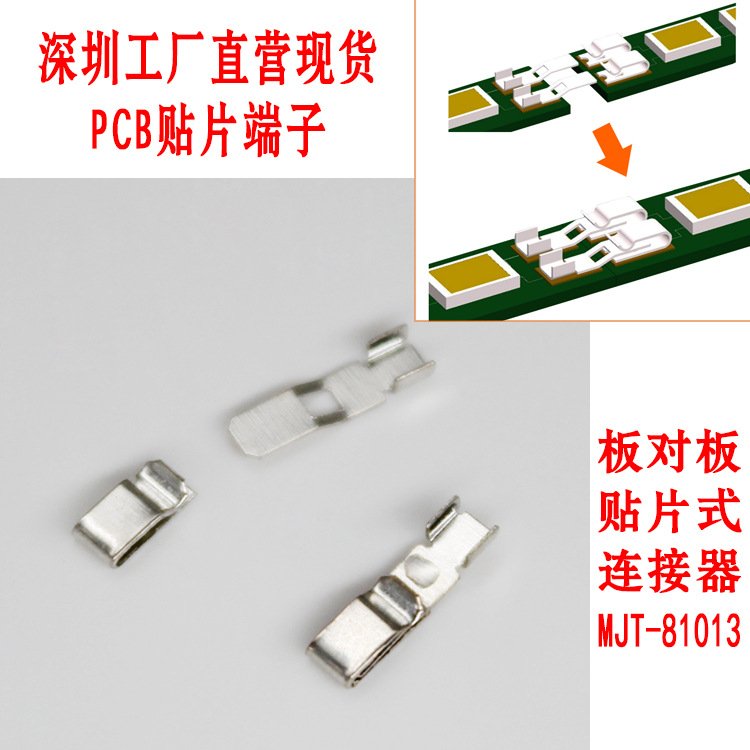
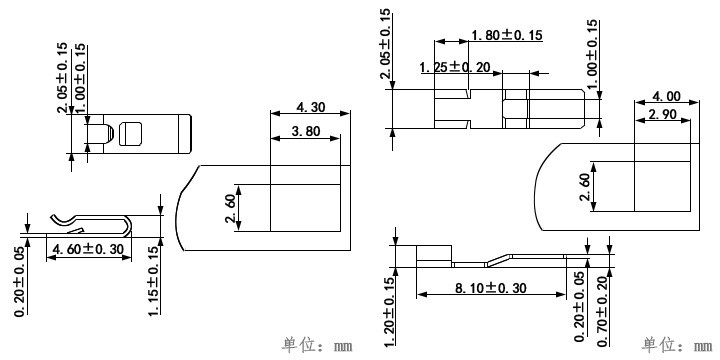
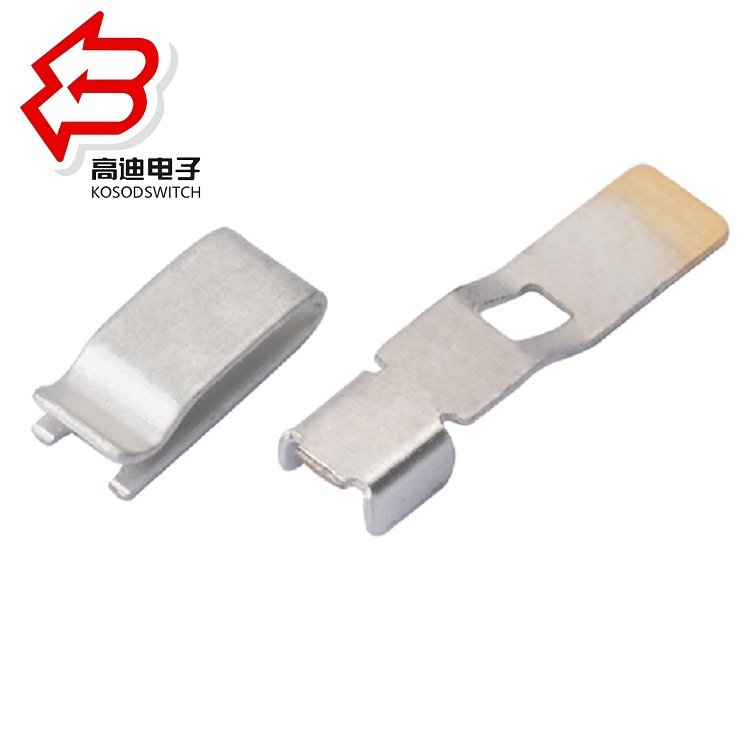
A stamped tab soldered flat on one board slides into a stamped spring socket soldered flat on the other, joining two boards in the same plane with nothing but metal: about 1.2 mm tall, on one face only, with the boards almost touching. Keystone and MAC8 make the gold-plated originals. The Chinese LED-lighting trade makes the same thing in tin-plated phosphor copper for joining light-bar boards end to end, at roughly a tenth of the price. Both boards need a part soldered on, so the module is no longer a bare PCB, and at about 3 mm per contact a 51 mm edge holds 16 or 17 of them per face.
| maker | part | what it is | price per mated pair |
|---|---|---|---|
| Keystone (USA) | 6100 male / 6102 female | Reference. Gold over phosphor bronze, 10 A, tab 2.8 × 0.3 mm. | ≈ $1.1–1.2 at 1 k (6102 alone $0.58 at 1 k, $0.53 at 10 k at Mouser) |
| MAC8 (Japan) | KO-2-1 / KC-2-1, HDA / HDB strips (KEO series sheet) | Reference. Gold SMT pin and socket singles, and 1.27 / 2.54 mm strips, "for PCB parallel connection". | HDA-1-1 (1.27 mm, 40-way pin strip) ¥780 JPY ≈ $5 each in tens (Monotaro) |
| Shenzhen Mengjing 孟京科技 | MJT-81013 / MJT-810132 | All metal, stamped phosphor copper, tin. 3 A / 250 V, −45 to +125 °C, 270 °C reflow, tape and reel. The closest match to the gold originals. | ¥0.62 ≈ $0.09, MOQ 5–10 sets |
| Shenzhen Boruisen 铂瑞森 (BRSEN) | MJT-81013 | Same part numbers and price as Mengjing: almost certainly one source under two shop names. | ¥0.62 ≈ $0.09 |
| Dongguan Gaodi 高迪电子 (KOSODSWITCH) | Gd-I059 | All metal, 1-way male and female for T5/T8 lamp boards, brass with tin. | ¥1.61 ≈ $0.24 |
| Shenzhen Mingyun 明韵电子 (MYUNDZ) | 81014 / 81014L | Same contacts in an LCP housing, 1 to 4 ways at 1.8 mm pitch, pin lengths 4.2 / 5.8 / 7.5 mm, 1 A / 125 V. | ¥0.36–0.88 ≈ $0.05–0.13 (1-way ¥0.40) |
| Mengjing · Boruisen | 81014, 1 to 4 ways | Housed pair: female 4.9 mm deep, male 8.9 mm, 2.5 mm high, 1 A, tin. | ¥0.40–0.67 ≈ $0.06–0.10 |
| Wenzhou Dufu 都富 · Wenzhou Yijian 一键 | BB2005 · BB2005 | Housed LED-board plug and socket pairs. | ¥0.10–0.12 ≈ $0.015–0.018 |
| Shaoxing Qianrui 千睿 | G15 | Housed pair, 1.5 mm pitch. | ¥0.30 ≈ $0.045 at 10 k |
| Yueqing Hongsen 宏森 · Dongguan Handa 汉达 · Zhongshan Yangde 扬德 | LED-strip pair · pair · pair | Pin-header-style board-to-board pairs for LED strips. | ¥0.08–0.53 ≈ $0.01–0.08 |
| Mingyun · Mengjing | 2060-style link · 3-way | WAGO 2060-style board-to-board link pins: a loose bridge pushed into SMT sockets on both boards. | ¥0.20–0.40 ≈ $0.03–0.06 |
| Shenzhen Jiahongsheng 嘉洪盛 · Dongguan Saisite 赛思特 · Dongguan Deyoushi 得优仕 · Shenzhen Weilianda 伟联达 · Shenzhen Guangshengxin 广胜鑫 | strip · strip · strip · strip · strip | 1.27 mm horizontal SMT pin headers and sockets: the cheap equivalent of MAC8's HDA / HDB strips, and the only version of this idea that reaches 1.27 mm pitch. | ¥0.05–0.30 ≈ $0.007–0.045 per strip or per pin as listed |
Caveats. These are lighting parts: tin plating, no stated mating-cycle life, and tolerances of ±0.15 to ±0.30 mm on the stamped bodies. Only two distinct all-metal tool sets turned up (the 81013 and the Gd-I059). The recommended pad is 2.60 mm wide, so 3.0 mm is about the tightest pitch. Listed 1688 prices are for small lots and usually fall with quantity.
The custom "kiss slot" coupler
The custom part designed for V6 (write-ups: V6_edge_coupler_connector_design and V6_edge_coupler_v2_kiss_slot in the project). Same 1.27 mm, 70-way, 45.47 mm tongue as today's board, but half the length end to end, 5.0 mm thick instead of 8.9, and the two boards touch inside the housing. The same contact strip in a shorter housing gives the 2-way and 3-way versions in the table above.
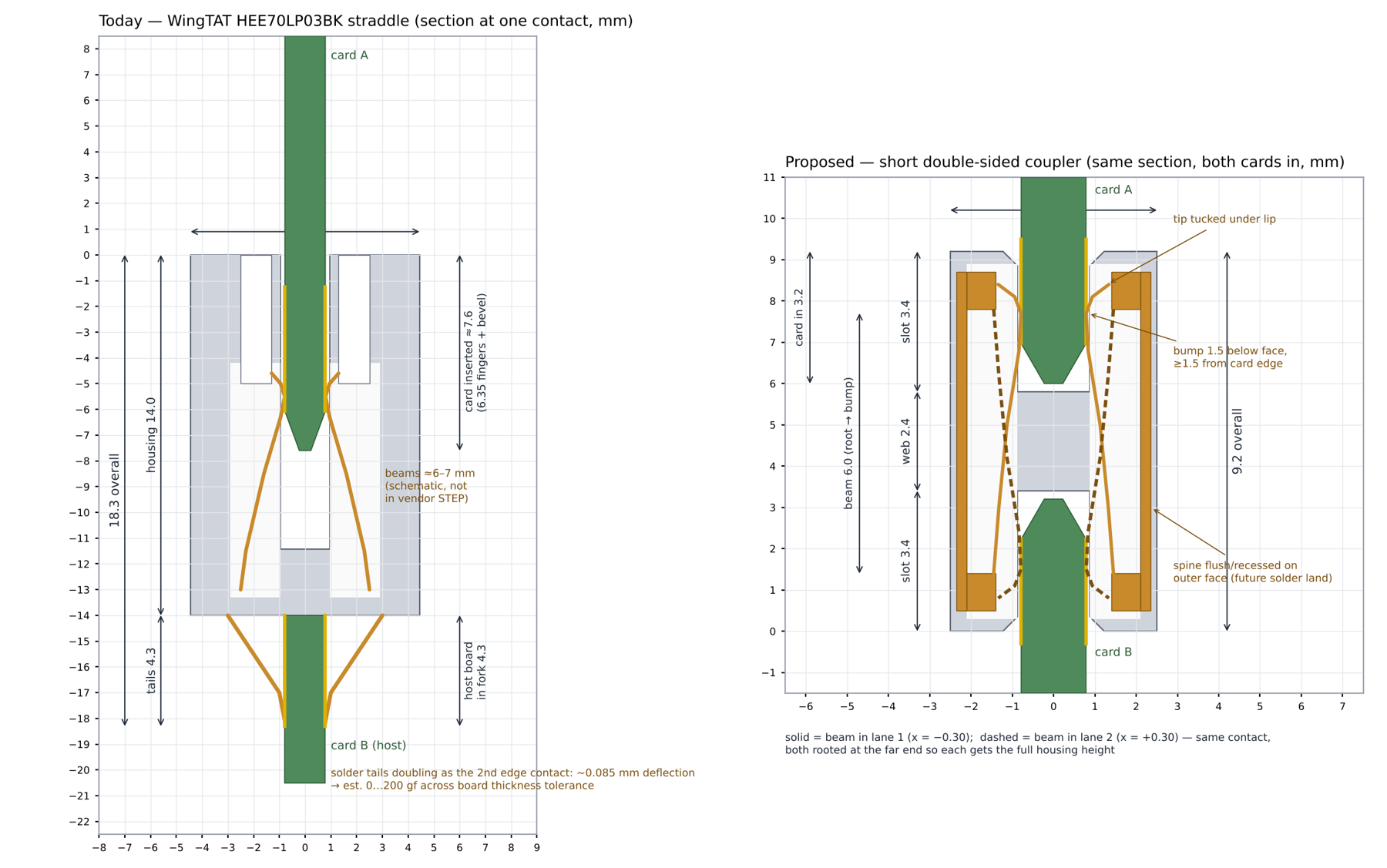
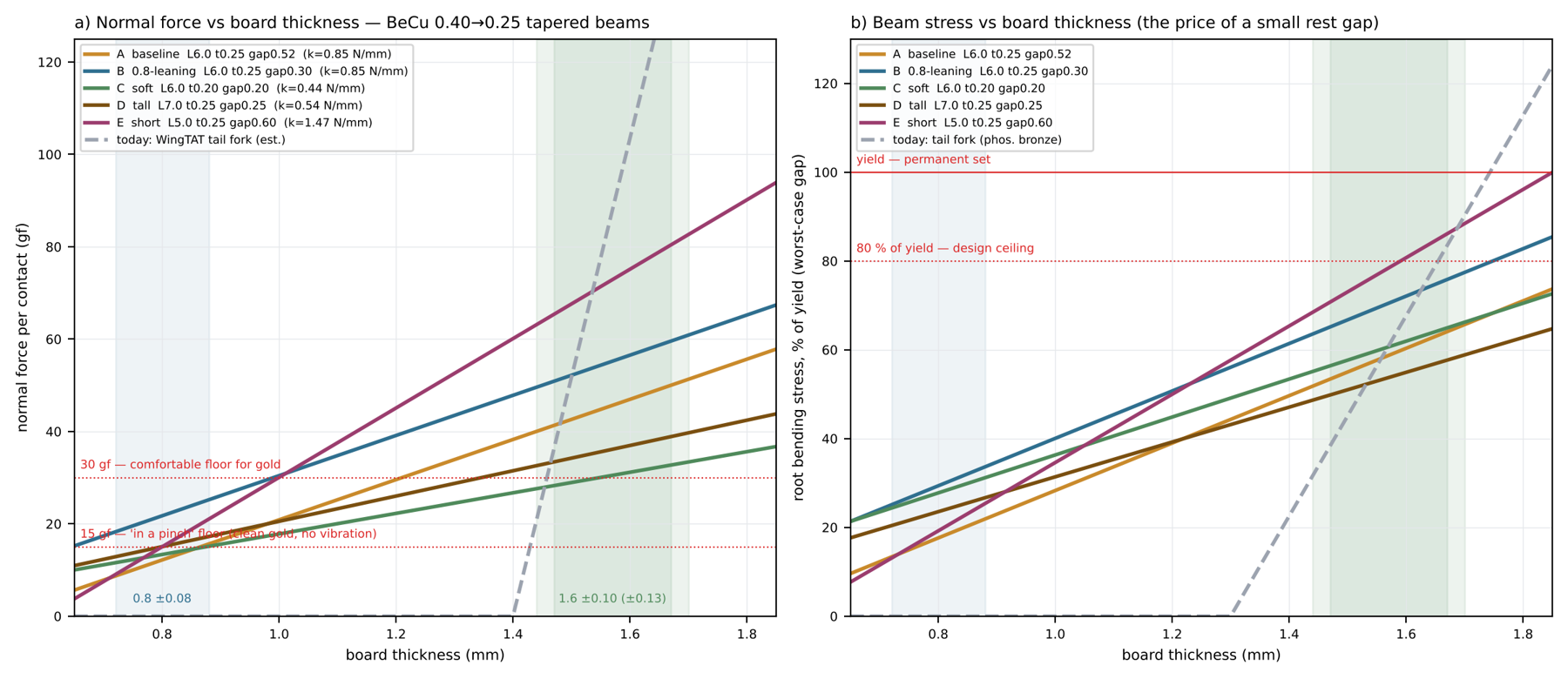
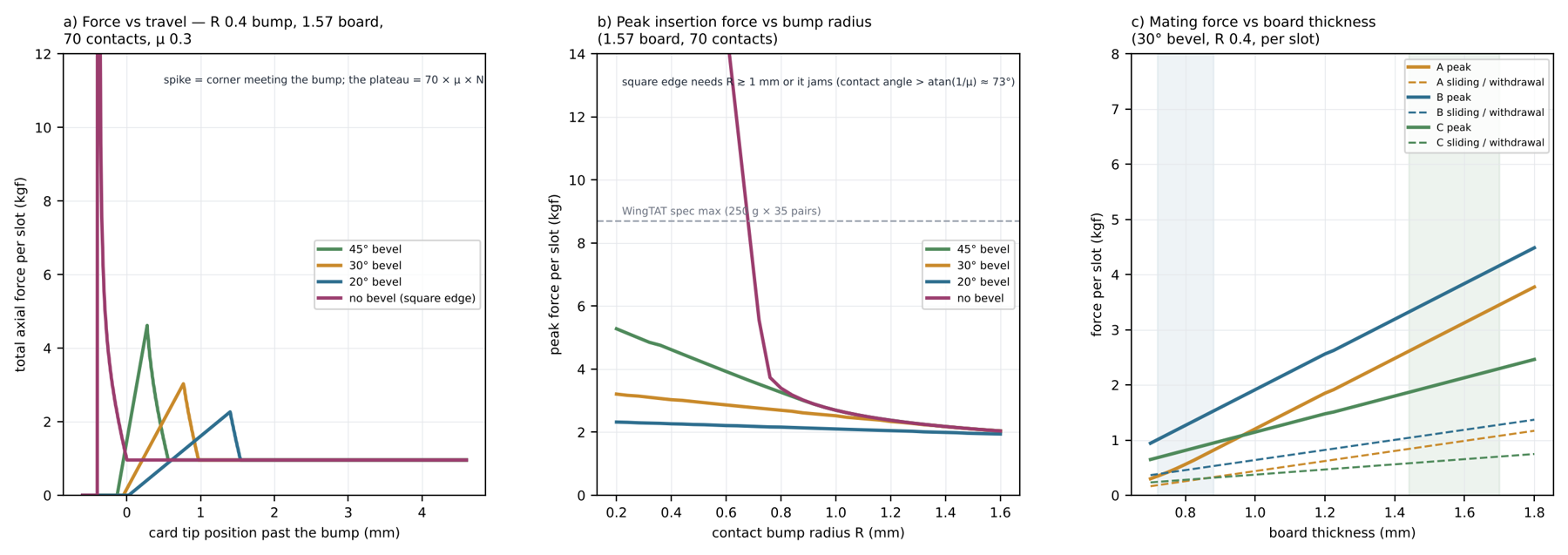
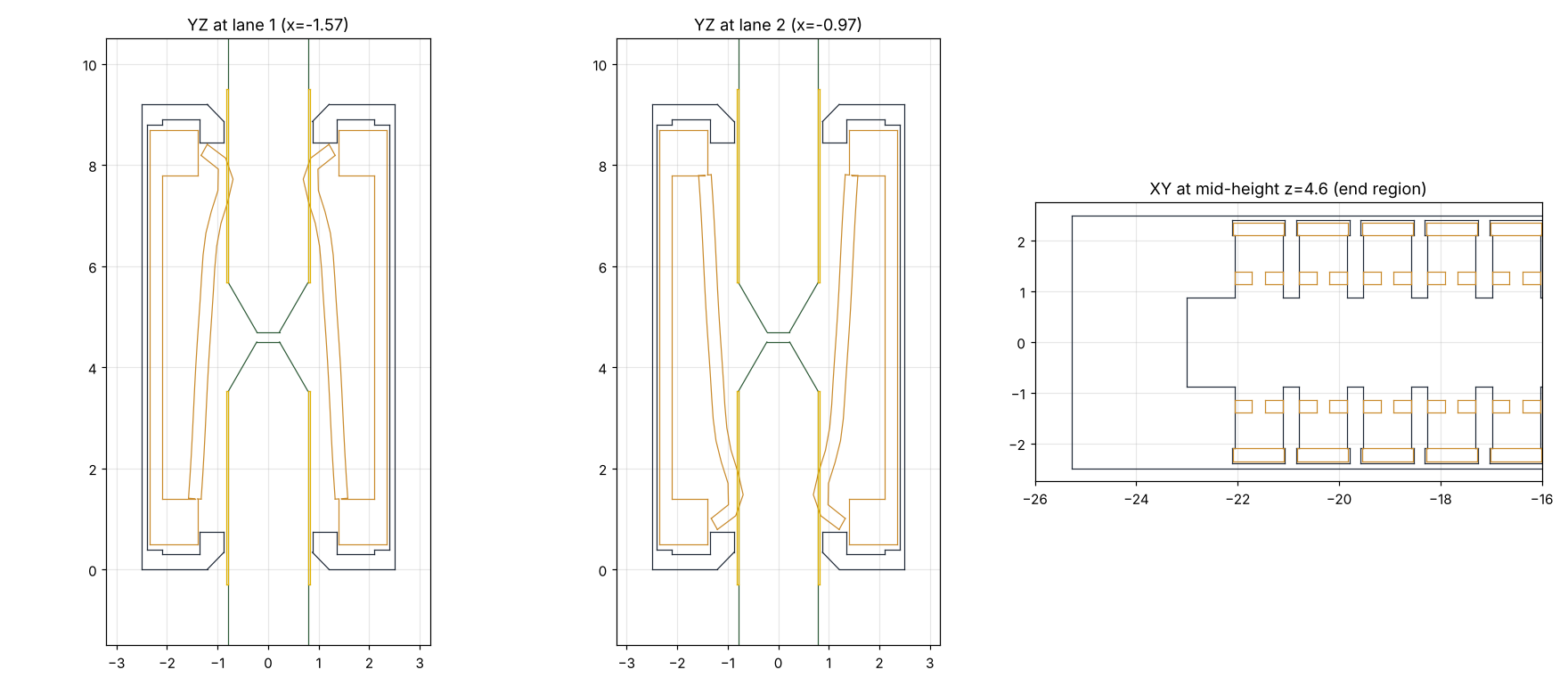
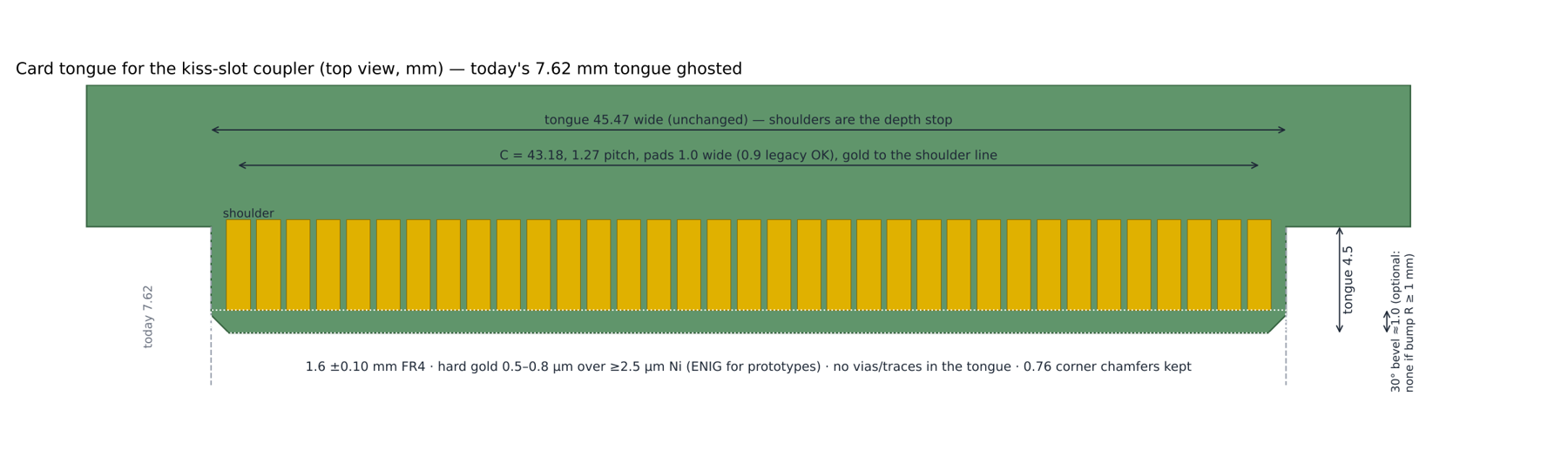
Models: all five variants side by side (STEP, 7 MB zip): today's WingTAT with cards, the 2.4 mm-web version, the kiss slot, a 7.8 mm short kiss slot and the 0.8 mm sister housing. Estimated cost at 10 k a year: $2.7–4.2 in BeCu, $1.5–2.6 in phosphor bronze (which needs about 0.5 mm more height), against $2.15 for the WingTAT; tooling $13–25 k. The point is size and the touching boards, not price.
Shorted-when-empty ("normalling") connectors
A card-edge connector whose two rows of contacts touch each other when the slot is empty and are spread onto the two faces of the card when one is inserted. It exists as a technique (telecom DSX patch bays call it normalling, the patents say make-before-break or switching contacts) but not as a current catalog part at any fine pitch. Everything that covered it has expired:
| US 4,087,151 | Magnetic Controls / ADC, 1977 | second "normalling" hump on each contact rests against its opposite number; the card touches the first hump before spreading the second (make-before-break) |
| US 4,514,030 | Methode, 1983 | three contact points per beam, the innermost shorts to the opposing contact |
| US 5,098,306 | Burndy, 1992 | card edge connector with switching contacts |
| US 5,286,215 | ADC Telecommunications, 1992 | normally-closed arms plus separate normally-open entrance springs |
| US 6,764,345 | Tyco, 2003 | dual shorting contacts in BeCu, mate-before-break |
The only card-edge part with evidence of doing it is vintage: a synth-diy thread about a Buchla 208 built with an Amphenol 225-22821-110 (0.156" pitch, 2 × 28) whose opposing contacts touch when empty; the common 225-22821-101 does not, so -110 may be the normalling variant, though no datasheet surfaced. Surplus 225-series parts run $30–50 each. For the custom coupler: just letting the bumps touch gives a 2 gf "short" and 96 % of yield at 1.70 mm; a real 10–15 gf normalled path costs about 1.5 mm of height (7–7.5 mm beams), and the patents' third-spring approach is the only way to get 20 gf without paying in height. In the kiss slot an empty end would join a card's front pad n to its own back pad n, which is a loop-back and not a pass-through; pass-through-when-empty belongs on a single-slot connector on the main board.
Not card edge, for reference
From the market survey (Oct 2026, LCSC / DigiKey / Alibaba listings): a 70-way link done with an FFC and two 0.5 mm flip-lock ZIFs costs about $0.50–0.70 (XUNPU FPC-05FB-60PH20 $0.20 at 1.5 k, 60-way 50 mm FFC $0.10 at 5 k; ZIFs are rated for about 20 mating cycles); a 1.27 mm 2 × 40 header pair about $0.5–0.8; a gold-wire zebra strip plus clamp $0.05–1 for the strip (500-actuation spec); discrete Chinese pogo pins $0.10–0.28 each at 1 k, so $7 or more per 70 contacts; Mill-Max pogos $0.56–0.92 each. Resin in an LCP housing is about $0.02; gold on 70 selectively plated contacts about $0.2–0.4; a 2-cavity housing tool in China $8–15 k. Also looked at and set aside: Amphenol Mini Cool Edge (0.6 mm, caged, $3.01 at 2.8 k, 15-week lead), Hirose FX27 (floating, 22 mm tall), Samtec MEC5-RA (11.4 mm deep).
Sources
Built 22 Nov 2026, last updated 23 Nov, from makers' drawings, distributor and 1688 listings, the V6 connector write-ups and two market surveys. Most product photos load from the vendors' sites; where one does not, the plan view in the table is the picture.